Open GL의 기본적인 코드는
https://developer.android.com/develop/ui/views/graphics/opengl
위 사이트에 공개된 코드를 사용하였다.
MainActivity.java
package com.example.open_gl_primitives;

import androidx.appcompat.app.AppCompatActivity;

import android.opengl.GLSurfaceView;
import android.os.Bundle;

public class MainActivity extends AppCompatActivity {

    private GLSurfaceView gLView;

    @Override
    protected void onCreate(Bundle savedInstanceState) {
        super.onCreate(savedInstanceState);
        // Create a GLSurfaceView instance and set it
        // as the ContentView for this Activity.
        gLView = new MyGLSurfaceView(this);
        setContentView(gLView);
    }
}
MyGLSurfaceView.java
package com.example.open_gl_primitives;


import android.content.Context;
import android.opengl.GLSurfaceView;

class MyGLSurfaceView extends GLSurfaceView {

    private final MyGLRenderer renderer;

    public MyGLSurfaceView(Context context){
        super(context);

        // Create an OpenGL ES 2.0 context
        setEGLContextClientVersion(2);

        renderer = new MyGLRenderer();

        // Set the Renderer for drawing on the GLSurfaceView
        setRenderer(renderer);
    }
}
MyGLRenderer.java
package com.example.open_gl_primitives;


import javax.microedition.khronos.egl.EGLConfig;
import javax.microedition.khronos.opengles.GL10;

import android.opengl.GLES20;
import android.opengl.GLSurfaceView;
import android.opengl.Matrix;

public class MyGLRenderer implements GLSurfaceView.Renderer {

    // vPMatrix is an abbreviation for "Model View Projection Matrix"
    private final float[] vPMatrix = new float[16];
    private final float[] projectionMatrix = new float[16];
    private final float[] viewMatrix = new float[16];

    private Primitives mPrimitives;

    public void onSurfaceCreated(GL10 unused, EGLConfig config) {
        // Set the background frame color
        //GLES20.glClearColor(0.0f, 0.0f, 0.0f, 1.0f);

        //배경색을 하얀색을 바꿔줌
        GLES20.glClearColor(1.0f, 1.0f, 1.0f, 1.0f);

        mPrimitives = new Primitives();
    }

    public void onDrawFrame(GL10 unused) {
        // Redraw background color
        GLES20.glClear(GLES20.GL_COLOR_BUFFER_BIT);

        // Set the camera position (View matrix)
        Matrix.setLookAtM(viewMatrix, 0, 0, 0, -3, 0f, 0f, 0f, 0f, 1.0f, 0.0f);

        // Calculate the projection and view transformation
        Matrix.multiplyMM(vPMatrix, 0, projectionMatrix, 0, viewMatrix, 0);

        mPrimitives.draw(vPMatrix);
    }

    public void onSurfaceChanged(GL10 unused, int width, int height) {
        GLES20.glViewport(0, 0, width, height);

        float ratio = (float) width / height;

        // this projection matrix is applied to object coordinates
        // in the onDrawFrame() method
        Matrix.frustumM(projectionMatrix, 0, ratio, -ratio, -1, 1, 3, 7);

    }

    public static int loadShader(int type, String shaderCode){

        // create a vertex shader type (GLES20.GL_VERTEX_SHADER)
        // or a fragment shader type (GLES20.GL_FRAGMENT_SHADER)
        int shader = GLES20.glCreateShader(type);

        // add the source code to the shader and compile it
        GLES20.glShaderSource(shader, shaderCode);
        GLES20.glCompileShader(shader);

        return shader;
    }
}
이와 같은 코드를 이용해 MyGLRenderer.java class 에서 배경색을 지정해준다.
public void onSurfaceCreated(GL10 unused, EGLConfig config) {

    //Set the background frame color 배경색을 하얀색을 바꿔줌
    GLES20.glClearColor(1.0f, 1.0f, 1.0f, 1.0f);

    mPrimitives = new Primitives();
}
Primitives.java
package com.example.open_gl_primitives;

import android.opengl.GLES20;

import java.nio.ByteBuffer;
import java.nio.ByteOrder;
import java.nio.FloatBuffer;

public class Primitives {

    private final String vertexShaderCode =
            // This matrix member variable provides a hook to manipulate
            // the coordinates of the objects that use this vertex shader
            "uniform mat4 uMVPMatrix;" +
                    "attribute vec4 vPosition;" +
                    "void main() {" +
                    // the matrix must be included as a modifier of gl_Position
                    // Note that the uMVPMatrix factor *must be first* in order
                    // for the matrix multiplication product to be correct.
                    "  gl_Position = uMVPMatrix * vPosition;" +
                    "}";

    // Use to access and set the view transformation
    private int vPMatrixHandle;

    private FloatBuffer vertexBuffer;

    private final int mProgram;

    private int positionHandle;
    private int colorHandle;

    //private final int vertexCount = triangleCoords.length / COORDS_PER_VERTEX;
    private final int vertexStride = COORDS_PER_VERTEX * 4; // 4 bytes per vertex

    // number of coordinates per vertex in this array
    static final int COORDS_PER_VERTEX = 3;

//    static float triangleCoords[] = {   // in counterclockwise order:
//            -0.5f,  0.622008459f, 0.0f, // top
//            -0.5f, -0.311004243f, 0.0f, // bottom left
//            0.5f, -0.311004243f, 0.0f  // bottom right
//    };

    float Vertex_coor[] = {
            // X, Y, Z
            0.5f, 0.5f, 0,      //v0
            -0.5f, 0.5f, 0,     //v1
            0.0f,  0.2f, 0,     //v2
            -0.3f, -0.2f, 0,     //v3
            0.3f, -0.3f, 0,    //v4
            0.0f,  -0.8f, 0     //v5
    }; //vertex(점)을 바꿔주면 삼각형이 아닌 다른 값들을 넣어줘 다른 모양을 만들어줄 수 있음


    // Set color with red, green, blue and alpha (opacity) values
    float color[] = { 0.63671875f, 0.76953125f, 0.22265625f, 1.0f };

    //set color to black (색을 검정으로 바꿔줌)
    float color_black[] = { 0.0f, 0.0f, 0.0f, 0.0f };

    public Primitives() {
        // initialize vertex byte buffer for shape coordinates
        ByteBuffer bb = ByteBuffer.allocateDirect(
                // (number of coordinate values * 4 bytes per float)
                Vertex_coor.length * 4);
        // use the device hardware's native byte order
        bb.order(ByteOrder.nativeOrder());

        // create a floating point buffer from the ByteBuffer
        vertexBuffer = bb.asFloatBuffer();
        // add the coordinates to the FloatBuffer
        vertexBuffer.put(Vertex_coor);
        // set the buffer to read the first coordinate
        vertexBuffer.position(0);

        int vertexShader = MyGLRenderer.loadShader(GLES20.GL_VERTEX_SHADER,
                vertexShaderCode);
        int fragmentShader = MyGLRenderer.loadShader(GLES20.GL_FRAGMENT_SHADER,
                fragmentShaderCode);

        // create empty OpenGL ES Program
        mProgram = GLES20.glCreateProgram();

        // add the vertex shader to program
        GLES20.glAttachShader(mProgram, vertexShader);

        // add the fragment shader to program
        GLES20.glAttachShader(mProgram, fragmentShader);

        // creates OpenGL ES program executables
        GLES20.glLinkProgram(mProgram);
    }

    public void draw(float[] mvpMatrix) {

        // get handle to shape's transformation matrix
        vPMatrixHandle = GLES20.glGetUniformLocation(mProgram, "uMVPMatrix");

        // Pass the projection and view transformation to the shader
        GLES20.glUniformMatrix4fv(vPMatrixHandle, 1, false, mvpMatrix, 0);

        // Add program to OpenGL ES environment
        GLES20.glUseProgram(mProgram);

        // get handle to vertex shader's vPosition member
        positionHandle = GLES20.glGetAttribLocation(mProgram, "vPosition");

        // Enable a handle to the triangle vertices
        GLES20.glEnableVertexAttribArray(positionHandle);

        // Prepare the vertex coordinate data
        GLES20.glVertexAttribPointer(positionHandle, COORDS_PER_VERTEX,
                GLES20.GL_FLOAT, false,
                vertexStride, vertexBuffer);

        // get handle to fragment shader's vColor member
        colorHandle = GLES20.glGetUniformLocation(mProgram, "vColor");

        // Set color for drawing the object
        GLES20.glUniform4fv(colorHandle, 1, color_black, 0);

        //Draw the object (2개의 vertex를 읽어 선을 그린다)
        GLES20.glDrawArrays(GLES20.GL_LINES, 0, 2);

        // Draw the object (6개의 vertex를 읽어 선을 그린다)
        //GLES20.glDrawArrays(GLES20.GL_LINES, 0, 6);

        // Draw the object (1번 vertex부터 읽어 4번 vertex까지 그린다)
        //GLES20.glDrawArrays(GLES20.GL_LINES, 1, 4);

        // Draw the object (line_strip은 0부터 3개 이어서 그려줌) 0 1 2 (총 3개)
        //GLES20.glDrawArrays(GLES20.GL_LINE_STRIP, 0, 3);

        // Draw the object (line_strip은 0부터 6개 이어서 그려줌) 0 1 2 3 4 5 (총 6개)
        //GLES20.glDrawArrays(GLES20.GL_LINE_STRIP, 0, 6);

        // Draw the object (line_strip은 1부터 3개 이어서 그려줌) 1 2 3 (총 3개)
        //GLES20.glDrawArrays(GLES20.GL_LINE_STRIP, 1, 3);

        // Draw the object (line_loop 0부터 6개 다 이어서 루프형식으로 그려줌, 마지막 0과 5를 합쳐줌) 0 1 2 3 4 5 (총 6개)
        //GLES20.glDrawArrays(GLES20.GL_LINE_LOOP, 0, 6);

        // Draw the object (line_loop 0부터 4개 다 이어서 루프형식으로 그려줌, 마지막 0과 3를 합쳐줌) 0 1 2 3 (총 4개)
        //GLES20.glDrawArrays(GLES20.GL_LINE_LOOP, 0, 4);

        // Draw the object(0부터 시작해서 3개의 점을 이어 안을 색칠해 준다) 0 1 2
        //GLES20.glDrawArrays(GLES20.GL_TRIANGLES, 0, 3);

        //vertex 3개가 하나의 삼각형을 만듬  0 1 2 하나 3 4 5 하나 총 두개의 삼각형을 만들 수 있음음
        //GLES20.glDrawArrays(GLES20.GL_TRIANGLES, 0, 6);

        //시작점도 바꿔줄 수 있음 1 2 3으로 만든 삼각형
        //GLES20.glDrawArrays(GLES20.GL_TRIANGLES, 1, 3);

        //임의적으로 vertex(0,0)을 생성해 하나 더 삼각혐 만들어버림 (뭥미?!)
        //GLES20.glDrawArrays(GLES20.GL_TRIANGLES, 1, 6);

        //3개 이상의 점을 이용해 삼각형의 형태를 만들고 싶을 때 사용하는 함수 / 0 1 2 하나 1 2 3 하나 두개의 삼각형이 합쳐서 보여짐
        //GLES20.glDrawArrays(GLES20.GL_TRIANGLE_STRIP, 0, 4);

        // 0 1 2 하나 1 2 3 하나 2 3 4 하나 3 4 5 하나 총 4개의 삼각형이 합쳐진 형태
        //GLES20.glDrawArrays(GLES20.GL_TRIANGLE_STRIP, 0, 6);

        //1 2 3 하나 2 3 4 하나
        //GLES20.glDrawArrays(GLES20.GL_TRIANGLE_STRIP, 1, 4);

        //0 1 2 하나 0 2 3 하나 두개의 삼각형이 만들어짐 , 두번쨰 삼각형 제작시 0 사용
        //GLES20.glDrawArrays(GLES20.GL_TRIANGLE_FAN, 0, 4);

        //1 2 3 하나 1 3 4 하나 두개의 삼각형이 만들어짐, 두번 쨰 삼각형 제작시 1 사용
        //GLES20.glDrawArrays(GLES20.GL_TRIANGLE_FAN, 1, 4);


        // Disable vertex array
        GLES20.glDisableVertexAttribArray(positionHandle);

    }

    private final String fragmentShaderCode =
            "precision mediump float;" +
                    "uniform vec4 vColor;" +
                    "void main() {" +
                    "  gl_FragColor = vColor;" +
                    "}";
}
float Vertex_coor[] = {
// X, Y, Z
0.5f, 0.5f, 0, //v0
-0.5f, 0.5f, 0, //v1
0.0f, 0.2f, 0, //v2
-0.3f, -0.2f, 0, //v3
0.3f, -0.3f, 0, //v4
0.0f, -0.8f, 0 //v5
}; //vertex(점)을 바꿔주면 삼각형이 아닌 다른 값들을 넣어줘 다른 모양을 만들어줄 수 있음위와 같이 선을 그리게 될 점의 위치를 지정해준다.
// Set color with red, green, blue and alpha (opacity) values
float color[] = { 0.63671875f, 0.76953125f, 0.22265625f, 1.0f };

//set color to black (색을 검정으로 바꿔줌)
float color_black[] = { 0.0f, 0.0f, 0.0f, 0.0f };
아래 URL을 이용해 원하는 색의 RGB 값을 지정해준다.
colors calculator: https://www.rapidtables.com/web/color/RGB_Color.html
RGB Color Codes Chart 🎨
RGB Color Codes Chart RGB color picker | RGB color codes chart | RGB color space | RGB color format and calculation | RGB color table RGB color picker RGB color codes chart Hover with cursor on color to get the hex and decimal color codes below: RGB color
www.rapidtables.com

// Draw the object (1번 vertex부터 읽어 4번 vertex까지 그린다)
GLES20.glDrawArrays(GLES20.GL_LINES, 1, 4);
위와 같은 코드는 GL_LINES를 이용해 1번부터 4번까지 지정된 점을 이용하는데 1,2번을 이용한 직선, 3, 4번을 이용한 직선.
두개의 직선을 "따로" 그리게 된다.

// Draw the object (line_strip은 0부터 6개 이어서 그려줌) 0 1 2 3 4 5 (총 6개)
GLES20.glDrawArrays(GLES20.GL_LINE_STRIP, 0, 6);
위와 같은 코드는 GL_LINE_STRIP을 이용해 0번부터 5번까지 총 6개의 점을 이용해
"하나"의 직선을 그려준다.

//Draw the object (line_loop 0부터 6개 다 이어서 루프형식으로 그려줌, 마지막 0과 5를 합쳐줌) 0 1 2 3 4 5 (총 6개)
GLES20.glDrawArrays(GLES20.GL_LINE_LOOP, 0, 6);
위와 같은 코드는 GL_LINE_LOOP를 이용해 0 1 2 3 4 5, 6개의 점을 이어 도형을 만들어준다.
즉, 0번과 5번 점을 이어 하나의 Loop을 만든다고 생각하면 된다.

// Draw the object(0부터 시작해서 3개의 점을 이어 안을 색칠해 준다) 0 1 2
GLES20.glDrawArrays(GLES20.GL_TRIANGLES, 0, 3);
위와 같은 콛드는 GL_TRIANGLES를 이용해 0, 1, 2, 3개의 점을 이어 도형을 그리고 안을 색칠해주는 코드이다.
색을 변경할 수도 있는데 이는 추후에 이용하겠다.
//vertex 3개가 하나의 삼각형을 만듬  0 1 2 하나 3 4 5 하나 총 두개의 삼각형을 만들 수 있음음
GLES20.glDrawArrays(GLES20.GL_TRIANGLES, 0, 6);
위와 같이 수를 설정할 경우 총 6개의 점을 이용해 2개의 삼각형을 만들 수 있다.
0 1 2 를 이용한 삼각형, 3 4 5 를 이용한 삼각형 두개의 삼각형을 그릴 수 있다.
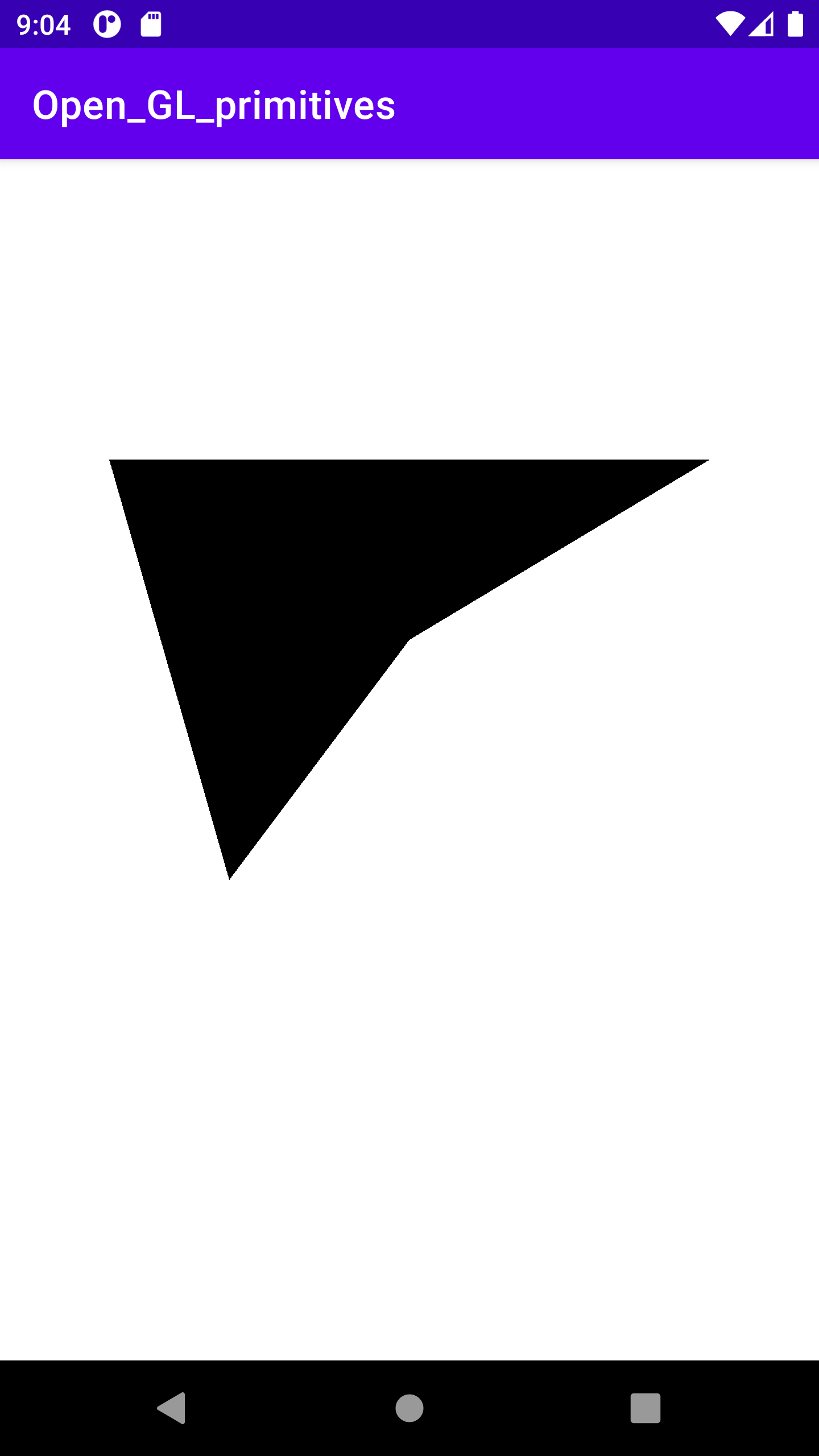
//3개 이상의 점을 이용해 삼각형의 형태를 만들고 싶을 때 사용하는 함수 / 0 1 2 하나 1 2 3 하나 두개의 삼각형이 합쳐서 보여짐
GLES20.glDrawArrays(GLES20.GL_TRIANGLE_STRIP, 0, 4);
위와 같은 코드는 GL_TRIANGLE_STRIP을 이용해 0 1 2 3, 총 4개의 점을 이용해 많은 삼각형을 그릴 수 있게 해주는 코드이다.
GL_TRIANGLES을 이용하면 3의 배수의 수가 있어야만 삼각형을 만들 수 있었는데 GL_TRIANGLE_STRIP 같은 경우
사용할 점의 개수를 임의로 넣어주어도 가능하다.
위와 같은 경우 총 4개의 점을 이용해 0 1 2 를 이용해 제작한 삼각형, 1 2 3 을 이용한 삼각형
총 두개의 삼각형을 그릴 수 있게된다.
// 0 1 2 하나 1 2 3 하나 2 3 4 하나 3 4 5 하나 총 4개의 삼각형이 합쳐진 형태
GLES20.glDrawArrays(GLES20.GL_TRIANGLE_STRIP, 0, 6);
이와 같이 6개의 점을 이용한 경우에도 마찬가지로
0 1 2 삼각형, 1 2 3 삼각형, 2 3 4 삼각형, 3 4 5 삼각형
총 4개의 삼각형을 그릴수 있게 된다.
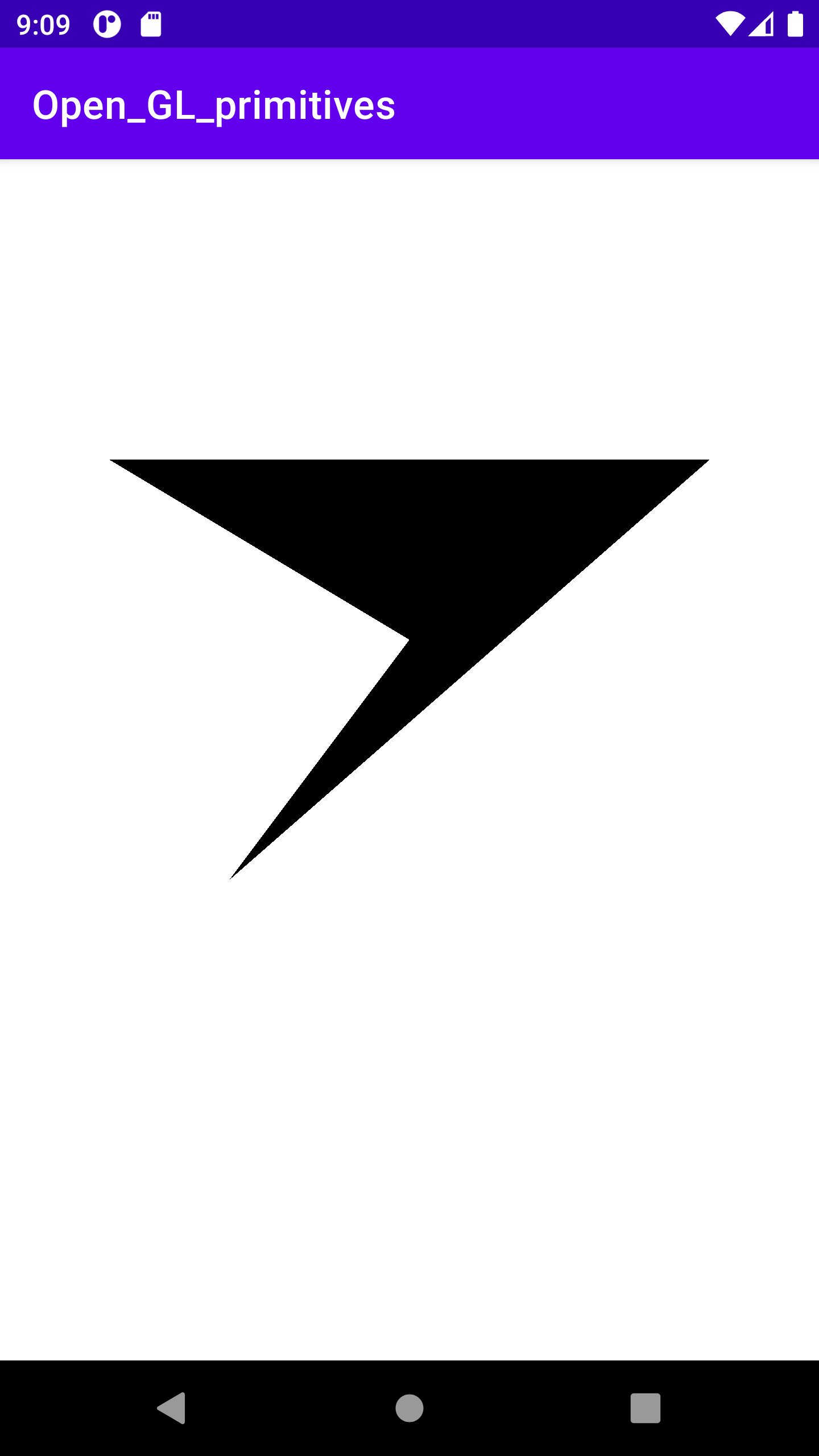
//0 1 2 하나 0 2 3 하나 두개의 삼각형이 만들어짐 , 두번쨰 삼각형 제작시 0 사용
GLES20.glDrawArrays(GLES20.GL_TRIANGLE_FAN, 0, 4);
위와 같은 코드는 GL_TRIANGLE_FAN을 이용해 삼각형을 그리게 된다.
앞에서 사용한 GL_TRIANGLE_STRIP과 차이점으로는 3개 이상의 점이 사용될 경우 마지막에 사용된 점을 이용하는 것이 아닌
제일 처음 사용한 점을 이용해 삼각형을 그린다는 것이다.
GL_TRIANGLE_STRIP의 경우 0부터 4개의 점이 있다고 가정하였을 떄,
0 1 2 / 1 2 3 두 개의 삼각형을 그리게 되지만
GL_TRIANGLE_FAN의 경우 동일하게 0부터 4개의 점이 있을 때,
0 1 2 / 0 2 3 두 개의 삼각형을 그리게 된다.
+참고자료
'실시간 운영체제' 카테고리의 다른 글
| [실시간 운영체제] Computer Graphics (Draw right angle triangle) (0) | 2023.06.14 |
|---|---|
| [실시간 운영체제] Open GL draw house (0) | 2023.06.14 |
| [실시간 운영체제] 버블정렬 (0) | 2023.05.04 |
| [실시간 운영체제] 연산 확인 작업 (pt.2) (0) | 2023.04.27 |
| [실시간 운영체제] 계산기 (0) | 2023.04.27 |


